WhatsApp
+66-957-269-990
- info@gosamuitours.com


The clear rules for visiting temples on Koh Samui, from what to wear to how to behave around monks, with the simple reasons behind each one.
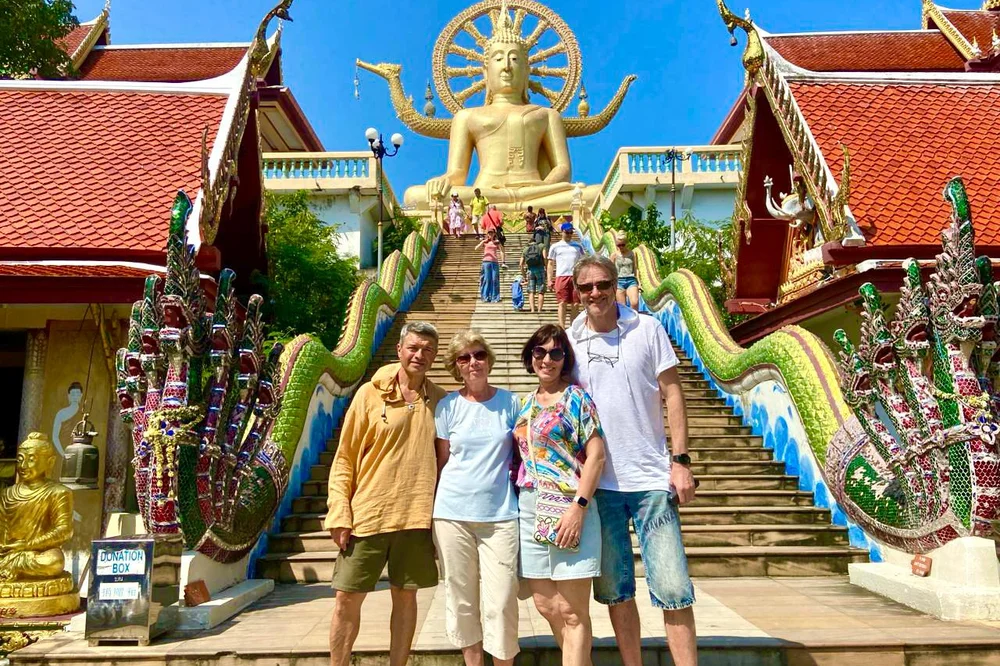
You have come down from the viewpoint in a tank top and shorts, the driver has pulled up at a temple, and suddenly everyone is looking at their knees. It is a very common moment on a Samui sightseeing day, and it takes about ten seconds to fix if you planned for it. Temple etiquette in Thailand is simpler than people fear, and it mostly comes down to a few habits and one piece of cloth in your bag.
It asks you to dress modestly, take off your shoes, keep your feet down and your voice low, and give monks and Buddha images their space. Nobody expects foreigners to know every custom, but they do notice whether you tried.

A temple in Thailand, a wat, is not a museum that happens to be religious. It is a working place of worship and often a home for monks. The grandmother lighting incense next to you came to pray, and you are a guest in that moment.
Samui is relaxed compared with somewhere like the Grand Palace in Bangkok, where dress checks are strict. You will see people in beachwear at the bigger temples here, and often nobody stops them. That does not mean it is fine: Thai people tend to avoid confrontation, so silence is not approval.
Here is the short version to keep on your phone:
| Situation | Do this | Avoid this |
|---|---|---|
| Clothing | Cover shoulders and knees, wear loose non-see-through clothes | Tank tops, short shorts, swimwear, bare chest |
| Shoes | Take them off at the door of any hall | Walking in with shoes, stepping on the door sill |
| Sitting | Tuck your feet to one side or behind you | Pointing your soles at a Buddha or monk |
| Monks | Give way, keep your head lower if you can, speak quietly | Touching a monk, women handing things directly |
| Photos | Ask if in doubt, stay quiet and discreet | Climbing on statues, joke poses, flash during prayers |
Cover your shoulders and your knees, and choose clothes that are not tight or see-through. This rule applies to men as well as women, which surprises many visitors, since shirtless men in shorts are just as out of place as women in bikini tops.
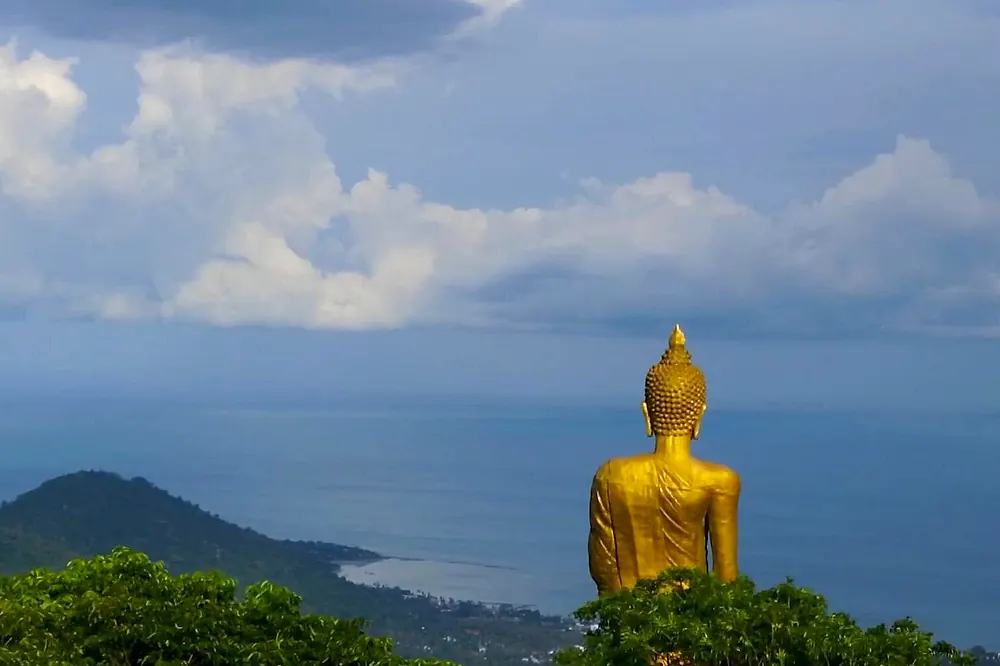
The simplest outfit is light trousers or a long skirt with a T-shirt that has proper sleeves. Linen and cotton are your friends here, because you will be walking around in serious heat. A loose long dress works very well too. If you buy nothing else at a local market, the cheap, loose cotton trousers sold all over the island are worth having.
A few things catch people out. Leggings count as covered in theory but look too tight for some places, so put something loose over them if you can. Ripped jeans with holes at the knee are not ideal. Clothing with a Buddha print feels respectful to some travellers, but many Thai people find it uncomfortable to see it worn as fashion.
Take your hat and sunglasses off when you go into a hall. If you have a visible tattoo of the Buddha, particularly on the lower body, cover it for the visit, because this can really offend people. It is not a small thing here, even if it means a lot to you personally.
Why all this modesty? In Thai culture, how you dress in a sacred place shows respect to the place and to everyone in it. Think of it less as a religious test and more as dressing properly for someone else's special occasion.
Because a sarong instantly turns beach clothes into temple clothes, and a Samui sightseeing day rarely stays in one category. One light sarong weighs nothing and covers your knees or your shoulders in seconds.

Think about how a typical day goes. You might swim under a waterfall in the morning, stop at a viewpoint, and arrive at Big Buddha in the afternoon. Nobody wants to wear long trousers in that heat from breakfast, and you should not have to. Tied at the waist it is a long skirt, and draped across the top it covers bare shoulders. Men can tie one too, and no one will laugh at you.
Some temples lend or rent wraps at the entrance, but do not count on it. It varies from place to place and can change, and a borrowed cloth that dozens of hot tourists have used is not the most pleasant thing. Your own costs very little at any market on the island and doubles as a beach towel, a sun shield and a bus blanket.
Wet swimwear is the other small trap. If your plan has a waterfall before a temple, pack a dry top and change first, because a soaking wet shirt rather defeats the purpose. It takes only a couple of minutes and you will feel a lot better too.
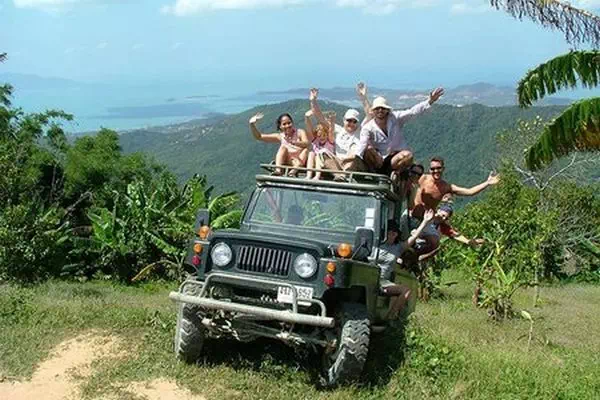
Both organised island tours take you through temples and nature on the same day, so they are exactly when you need that sarong. The Koh Samui jeep safari covers jungle, waterfalls, viewpoints and Buddhist temples with transfer and lunch from ฿1490. The military jeep safari, also from ฿1490, stops at Wat Khunaram, Namuang Waterfall, the Secret Buddha Garden and Big Buddha.
The classic jeep safari suits people who want a broad look at the island, and the military jeep suits anyone who wants a bit more fun on the road and the mummified monk on the list.
Shoes come off because they carry dirt into a sacred space, and feet matter because Thai culture treats them as the lowest part of the body, in contrast to the head as the highest. Whenever you sit in a temple, your soles must not point at a Buddha image or a monk.
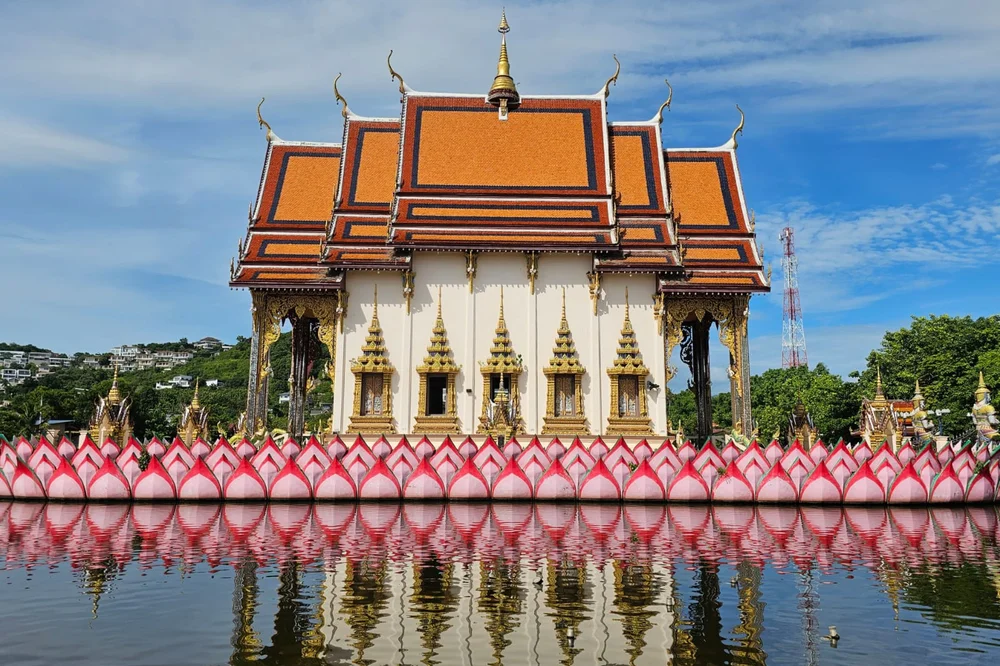
The practical rule is easy: if you see a pile of shoes at a door, add yours. You normally leave them on when walking around the grounds, and take them off before entering a hall that holds a Buddha image. Slip-on sandals save a lot of bending and buckling, since you may do this several times in a day.
When you enter a hall, step over the raised door sill instead of standing on it. Traditional belief says spirits live in the threshold, and even if you are not sure about that, stepping over is a small courtesy that older Thai people will notice and appreciate.
Inside, sit on the floor with your legs tucked to one side, the way you will see Thai women sitting. Your legs will complain after a while, and that is normal. Change sides, or get up quietly and leave, rather than stretching your feet out towards the altar.
The same logic explains a few other habits. Do not step over someone sitting on the floor, do not point at anything with your foot, and do not touch anyone on the head, including children. These rules apply outside temples too, so they are worth learning for the whole trip.
Give monks space and treat them with quiet respect, and if you are a woman, avoid all physical contact. A woman should never touch a monk or hand him something directly, because Thai monks keep strict vows, and contact with a woman, even by accident, breaks them.
This is not an insult to women. It is about the monk's own discipline, and he may have to go through a ritual to put it right. In practice, if you are a woman offering something, place it on the cloth or tray he holds out or on a nearby surface, and let him pick it up. Step aside on narrow paths, and do not sit right next to a monk on a bench or in a vehicle.
Men should also keep some distance, even though the rule is less strict for them. Do not offer a handshake or a hug for a photo, however friendly the monk seems. A polite wai, palms together at chest height with a small bow, is plenty. Do not be surprised if he does not return it, as monks generally do not.
Try to keep your head no higher than a seated monk's if you are close by. You do not need to crawl, but sitting down or bending a little as you pass shows you have thought about it. Talking to monks is usually fine, and some enjoy practising English with visitors, so do not be scared of a friendly chat.
If you happen to be out very early and see monks collecting alms, watch from a respectful distance and keep the camera low. Giving food is an act of faith for local people, not a show. Only join in if you genuinely want to and someone can show you how.
Usually yes, as most Samui temples allow photos, unless a sign says otherwise or a service is going on. Your behaviour in the photo matters more than the camera itself.
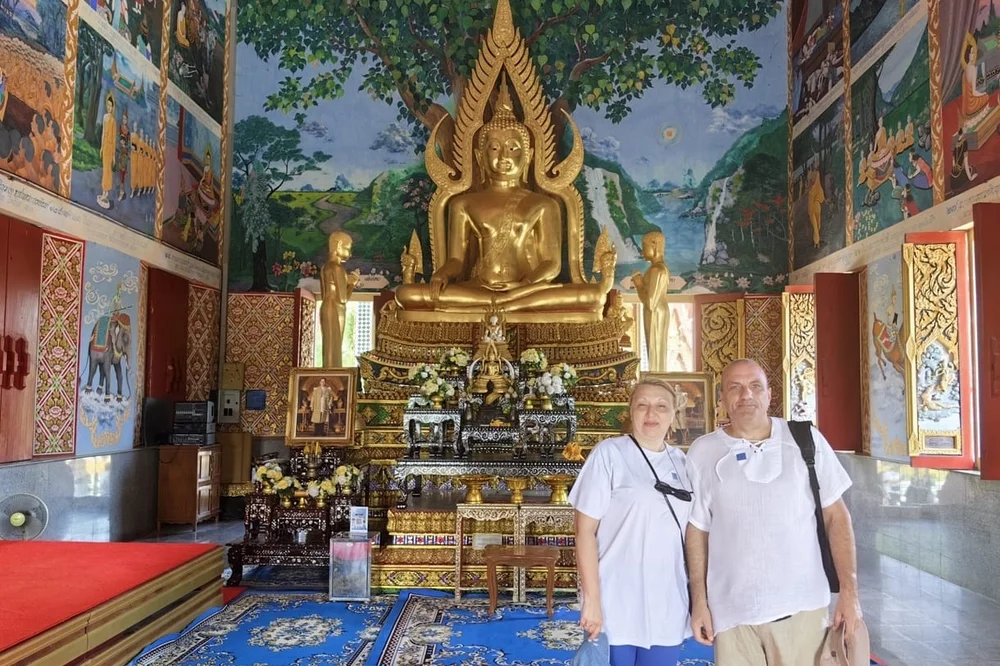
Never climb on a statue or base, touch a Buddha image, or pose with your arm around one. Avoid silly poses completely. Some Thais also dislike seeing a selfie taken with your back to the image, so if you want a photo with the Buddha, a slight angle and a calm, standing pose is a good way to do it.
Turn the flash off, mute your phone and put the drone away. If people are praying, take your picture from far away or wait until later. A close-up of someone mid-prayer is rude in any religion, and asking first is a simple courtesy. A smile and a raised phone usually get you a clear answer.
My honest opinion: you will get better pictures outside anyway. The light in the halls is dim and the best angles are usually on the terraces or across the water. That also means you are not the one blocking somebody's prayers.
The working temples need the most care, especially Wat Phra Yai, Wat Plai Laem and Wat Khunaram. Treat the Chinese shrines and the sculpture gardens with the same calm manners, even when the customs differ a little.
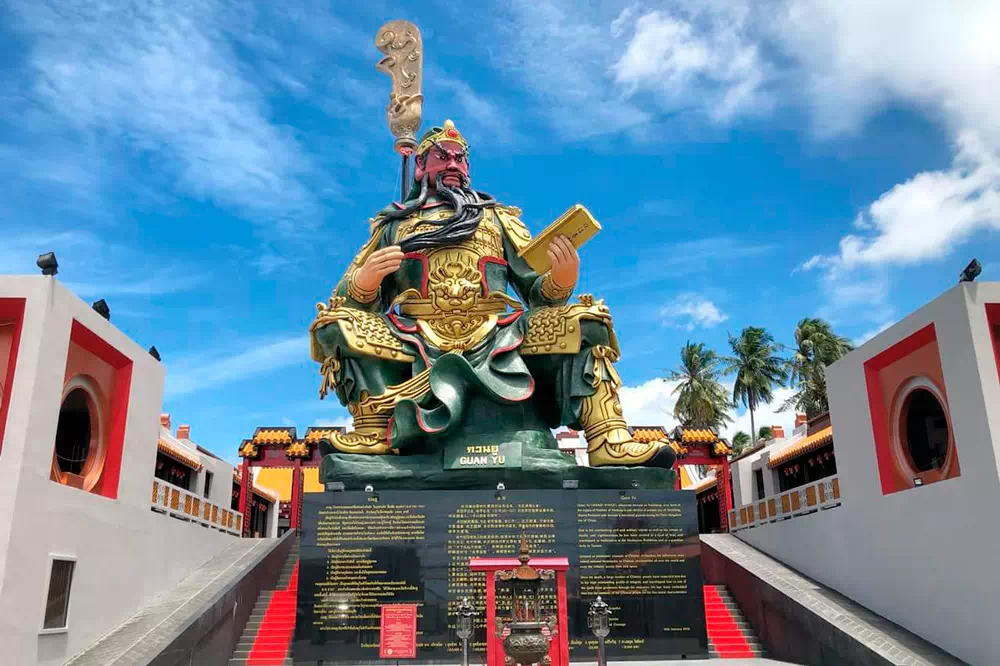
Big Buddha is the one most visitors see, and the stairs and terrace get crowded. This local's guide to Wat Phra Yai covers timing and how to avoid the worst of the heat. Wat Plai Laem nearby is very photogenic, and it is easy to forget that people worship there too.
Wat Khunaram is the home of the mummified monk, Luang Pho Daeng, and it deserves special care. He is a revered teacher, not a curiosity, however strange the sight of him sitting in a glass case with sunglasses on may seem. Stand back, keep your jokes for later, and be quiet.
The Secret Buddha Garden, up in the hills, is more of a sculpture garden than a temple, so the mood is lighter, but it is still polite not to climb on the figures. Buddhist holidays are also worth knowing about, because temples get very busy and alcohol sales can be limited on some dates. Check locally if your trip falls on one, and consider going along, as it is lovely to see.
Run through this list on the morning of a sightseeing day and you will cover almost everything:
Make the effort, and the mood towards you changes quickly. A small nod or a smile from an older lady at the door when she sees your covered shoulders is one of the nicest things on the island, and it costs nothing.
Many temples on the island are free to enter, and donation boxes are there for anyone who wants to give. Rules and charges for parking or special areas can change, so check on the day. Giving a donation is a nice gesture, but it is your choice.
Shorts that clearly cover the knee are usually accepted. Anything above the knee is not appropriate, for men or for women. When in doubt, tie a sarong over them before you walk in.
No, socks are generally fine, though most people here wear sandals and go barefoot inside. Keep in mind that polished floors can be slippery in socks. Just take care on steps.
Young children are treated kindly in Thai temples, and nobody expects perfect behaviour from them. Still, try to keep them from climbing on statues, shouting or running in the halls. Most kids enjoy the temple dogs, the colourful dragons and lighting incense with a parent.
Women can visit Samui's temples and halls as normal. A few temples in Thailand restrict women from certain inner areas of a chedi, so read any signs you see and respect them. If unsure, ask a staff member or simply stay in the public areas.
It is not a serious offence for a visitor, but walking clockwise, with the chedi on your right, is the traditional way. Follow the direction Thai visitors are taking. If there is a ceremony going on, it is best to wait or stand to one side.
No, you do not have to, and an over-enthusiastic wai to everyone can look odd. A wai to a monk or in front of a Buddha image is a polite gesture if you feel comfortable with it. A warm smile and a small nod work for everyone else.
Hotel pickup, insurance and a licensed local operator. Ask us anything on WhatsApp before you book.
Updated 25 November 2026.