WhatsApp
+66-957-269-990
- info@gosamuitours.com


A practical visitor guide to Wat Plai Laem on Koh Samui: what the 18-armed Guan Yin and the laughing Buddha mean, what to wear, when the light and the crowds are best, and how to pair it with the Big Buddha.

You come round a bend on the road towards Choeng Mon and suddenly there it is across the water: a huge figure with eighteen arms fanned out like the spokes of a wheel, reflected in a green lake. Most people stop the car without planning to. That is the usual way visitors meet Wat Plai Laem, and it is one of the most photographed temples on Koh Samui.
It is also a temple that rewards a little preparation. The symbols make more sense when someone explains them, the light changes everything for photos, and the heat and the tour buses can turn a lovely visit into a sweaty rush. Here is how I tell friends to do it.
Wat Plai Laem is a working Buddhist temple on the northeast tip of Koh Samui, built in and around a small lake close to the Big Buddha. Its main attraction is a giant statue of Guan Yin, the goddess of mercy, with eighteen arms, standing on a platform over the water.
"Plai Laem" means "the tip of the cape", which describes the location well: the temple sits near the end of the northeast headland, between Bang Rak and Choeng Mon. It is a modern temple, built in recent decades, and that shows in the bright colours and the clean, almost theatrical layout.
The complex mixes Thai Theravada Buddhism with Chinese Mahayana traditions. You will see a classic Thai ordination hall with a curved, tiered roof, and next to it figures from the Chinese world: Guan Yin, a jolly laughing Buddha and other guardians and deities. On Samui this mix feels natural, because many island families have Chinese roots, especially from Hainan.

Do not expect ancient ruins. Wat Plai Laem is not a historic site like the old temples of Ayutthaya; it is a living place of worship designed to be beautiful and full of meaning. Local people come to pray, make merit and feed the fish, and you will often see families bringing flowers and incense.
For most visitors, 30 to 60 minutes is enough to walk around the lake, see the main statues, step into the temple hall and feed the fish. It is a short, easy stop, which is exactly why it fits so well into a day on the island.
Guan Yin (in Thai, Kuan Im) is the bodhisattva of compassion, the one who hears the cries of the world and helps people in trouble. Her many arms show her many ways of helping: one pair of hands is never enough for all the suffering she sees.
In Chinese and Mahayana Buddhism, a bodhisattva is someone who has reached enlightenment but chooses to stay in the world to help others. Guan Yin is the most loved of them. Fishermen pray to her for safe seas, mothers for healthy children, and many Thai-Chinese people avoid eating beef out of respect for her.
Look closely at the hands and you will see each one holds a different object. These are symbols of her tools for helping people, such as a lotus for purity, a vase that pours out compassion, a wheel for the teaching of the Buddha and weapons that cut through ignorance and fear. You do not need to know every object; the idea is that she is ready for any kind of trouble.
The many-armed form is common in Chinese temples, but seeing it this big, out on the water, is unusual in Thailand. That is why the statue has become a symbol of Samui on postcards and travel posts. It is also why the platform in front of her is the busiest spot in the whole temple.
A small tip on behaviour: people pray here, so if someone is kneeling in front of the statue, wait for them to finish before you step in for a photo. Never climb on statues or railings for a better angle. It sounds obvious, but you will see someone do it almost every day.
Beyond Guan Yin, the two things worth your time are the big laughing Buddha and the ordination hall on the lake. Walk the full loop around the water: the quieter corners are often more interesting than the main photo spot.
The laughing Buddha is the round, smiling figure with a big belly, known in Chinese tradition as Budai. He is not the historical Buddha but a cheerful monk from Chinese folklore who stands for happiness, contentment and plenty. Many people rub his belly for good luck, and children usually love him far more than any other statue in the temple.

The ordination hall, or ubosot, sits on the lake and is built in Thai style with a tiered orange roof and golden details. Inside you will find Buddha images and painted walls. This is the most sacred part of the complex, so it is where the dress code matters most and where you must take off your shoes.

Around the lake there are smaller shrines, statues of guardians and spots with benches in the shade. If you visit with older relatives or small children, these shady spots are where you will spend half the visit, and that is fine. The temple is pleasant to sit in once you are out of the sun.
Yes, feeding the fish is one of the favourite things to do here, especially for children. Fish food is sold at small stalls by the water for a small donation, and the moment you throw it, the water boils with big fish.
The lake is full of large catfish and other fish that have learned exactly where visitors stand. Throw a handful and they crowd the surface, mouths open, pushing each other half out of the water. It is noisy, splashy and very funny for kids, and a little startling for some adults.
In Thai Buddhism, feeding animals is a way of making merit: a small good deed that adds to your karma. So when you see Thai families doing it, they are not only having fun, they are also making an offering. You are welcome to join in the same spirit.
Please use only the food sold at the temple. Bread, snacks and leftover lunch are bad for the fish and dirty the water. Prices for fish food and donations are small and can change, so just ask at the stall.
Watch small children near the edge. Some parts of the lake have railings, some are open, and excited kids leaning out over a mass of fish is a classic way to lose a hat or a phone, or worse.
Cover your shoulders and knees, and be ready to take off your shoes before entering the temple hall. This is a place of worship, and staff may stop you from entering the hall if you arrive in a beach top and shorts.
The simplest solution is a light shirt with sleeves and long trousers, a long skirt or a sarong. Many visitors carry a scarf or sarong in their bag and wrap it around when needed. Sometimes cover-ups are available to borrow or buy nearby, but do not count on it.
Here is a short list of temple manners worth knowing:
Sandals that slip on and off easily make life much easier at Thai temples. And because the paving around the lake heats up in the sun, have them ready the second you step outside the hall: barefoot on hot stone at noon is a lesson you only need once.
Go early in the morning or in the late afternoon. From late morning to early afternoon the heat is at its worst, the light is flat and harsh, and tour minibuses arrive one after another.
Wat Plai Laem is on the route of many island tours, so the main platform can go from empty to crowded in five minutes. Groups usually come in waves, stay for 20 or 30 minutes and move on to the Big Buddha. If you arrive and it is packed, walk the lake loop first; often the crowd is gone by the time you get back.
| Time of day | Light | Heat | Crowds |
|---|---|---|---|
| Early morning | Soft, calm water, good reflections | Pleasant | Quiet, mostly locals |
| Late morning to early afternoon | Harsh, strong shadows | Very hot, hot paving | Busiest, tour groups |
| Late afternoon | Warm, golden colours | Easing | Fewer groups |
| Cloudy or rainy day | Even light, colours stay rich | Comfortable | Usually quieter |
For photos, the classic shot is Guan Yin from across the water with her reflection, and that needs still water. Mornings are usually calmer; even a light breeze breaks the reflection. A wide-angle lens or phone setting helps to fit all eighteen arms in.
Season matters too. From roughly October to December Samui gets its heavy rains, and a short shower can clear the temple of visitors and leave beautiful soft light afterwards. For the full weather picture, see our month by month guide to the best time to visit Koh Samui.
Bring water and a hat whatever the time of day. There is limited shade on the main platforms, and the white and coloured surfaces reflect the sun up at you. Ten minutes at noon feels like thirty.
The Big Buddha temple, Wat Phra Yai, is only a few minutes away by car, so it makes sense to see both in one trip. Start with Wat Plai Laem while the water is calm, then drive to the Big Buddha before the heat peaks.

The Big Buddha is the golden seated statue on the small island of Koh Faan, joined to Samui by a causeway. It is the island's best-known landmark, and you need the same modest clothing there, so dress once for both temples. A full guide to the Big Buddha is coming soon on our blog, so I will keep it short here.
A relaxed half day on this corner of the island could look like this:
If you do not want to drive a scooter or haggle with taxis, a tour is the easiest way. The Military Jeep Safari on Koh Samui from ฿1490 includes the Big Buddha temple, the mummified monk at Wat Khunaram, a waterfall swim and the Secret Buddha Garden, with hotel transfer and a Thai lunch. The Koh Samui Jeep Safari from ฿1490 is a full day around the island through jungle, viewpoints, waterfalls and Buddhist temples. Ask on WhatsApp which temples are on the route on your date if Plai Laem is a must for you.
Both suit first-timers who want the island's temples and nature in one day without planning anything; the military version is the more playful ride in open army jeeps:
Wat Plai Laem is easy to visit on your own, and entry is free; donation boxes are there if you want to give something. Opening hours can change, so check locally, but it is usually open from early morning until early evening.
A quick checklist before you go:

Taxis and scooters both work for getting there, and parking is right by the lake. If you are staying in Chaweng, Bophut or Choeng Mon, it is a short ride; from Lamai or the west coast, combine it with other sights so the drive is worth it.
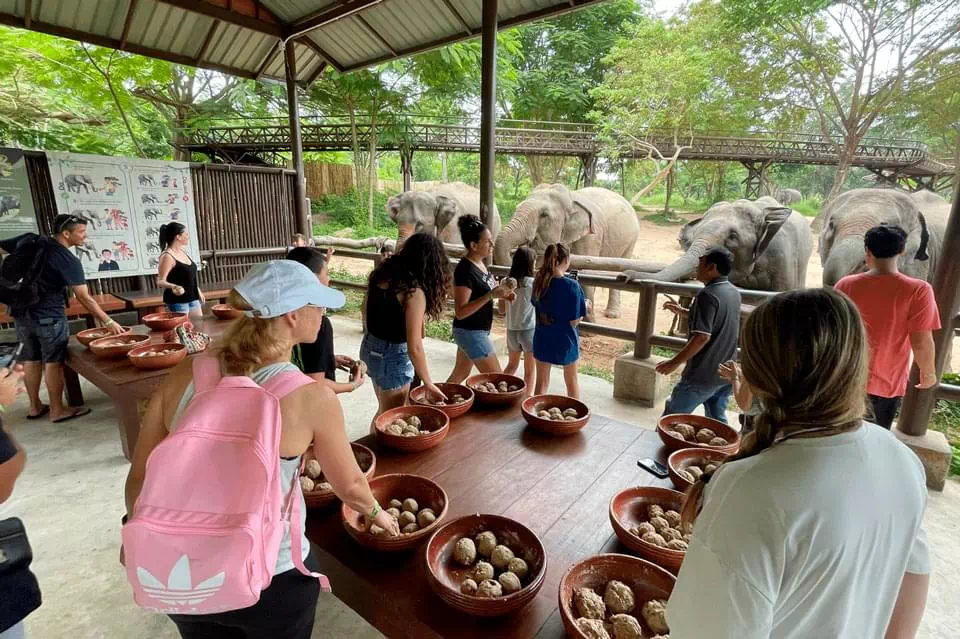
If temples are only a small part of your plans, pair the morning with something completely different later in the week, like the ethical Samui Elephant Kingdom sanctuary, where there is no riding and no chains. And if you are still building your list, our 10 best tours in Koh Samui is a good place to start.
No, entry to Wat Plai Laem is free. There are donation boxes and small stalls selling fish food and offerings. Giving a little is appreciated but never required.
Most visitors spend 30 to 60 minutes walking around the lake, seeing the statues, visiting the temple hall and feeding the fish. Photographers who wait for good light may stay longer. It fits easily into a morning together with the Big Buddha.
It is on the northeast tip of Koh Samui, between Bang Rak (Big Buddha Beach) and Choeng Mon, a short drive from the Big Buddha. Most taxi and scooter drivers know it by name. It is also not far from the airport, so some people stop on their way in or out.
Yes, it is one of the most child-friendly temples on Samui. Children love feeding the fish and the round, smiling laughing Buddha. Keep a close eye on them near the open edges of the lake.
Both, in a way. Guan Yin is a bodhisattva of compassion in Mahayana Buddhism, which is followed mainly in China and East Asia, and she is also deeply loved in Chinese folk religion. In Thailand she is known as Kuan Im and is popular among Thai-Chinese families.
Yes, and a cloudy or rainy day can actually be pleasant: the paving is cooler, the colours look rich and there are fewer visitors. Bring an umbrella and shoes that do not slip on wet tiles. Heavy showers on Samui are often short, so you can wait under a roof.
Rules on drones change and temples may not welcome them, especially when people are praying. Ask at the temple before flying, and respect any signs or staff instructions. In most cases, a phone with a wide-angle setting gets the classic shot without problems.
Hotel pickup, insurance and a licensed local operator. Ask us anything on WhatsApp before you book.
Updated 11 November 2026.