WhatsApp
+66-957-269-990
- info@gosamuitours.com


A clear checklist for telling a real elephant sanctuary from a tourist camp with a new sign, why riding is the line you should never cross, and how Samui Elephant Kingdom measures up.

Drive along the ring road on Samui and you will see the word "sanctuary" on more signs than you would expect for one island. Some of those places have changed the way they work with elephants, others have only changed the sign. Choosing an ethical elephant sanctuary in Koh Samui is not hard, but it does mean looking past the name and asking a few direct questions.
This guide gives you the criteria I use when friends ask me where to see elephants, explains why riding is the clear line, and shows how one park on the island fits those standards. I will not name or attack other places. The point is to give you the tools to judge any of them yourself.
An ethical elephant sanctuary is a place where the elephants' needs come first and visitors fit around them, not the other way round. In practice that means no riding, no shows, no chained elephants waiting for tourists, and enough space for the animals to walk, forage, bathe and choose their own company.

These are the six criteria I look for, in order of importance:
None of these is a secret. A place that meets them will usually be proud to explain how it works. A place that does not will often change the subject, or tell you the elephant "enjoys" the activity.
The table below is the quick version I keep in my head when I read a tour description or watch a park's videos.
| What to check | Good sign | Red flag |
|---|---|---|
| Riding | Not offered at all | Offered as an extra or "gentle" option |
| Entertainment | Watching normal behaviour | Tricks, painting, music or a show schedule |
| Restraint | Elephants move freely in open space | Elephants chained at a feeding station all day |
| Origin | Clear rescue stories for each animal | Vague answers or baby elephants with no mother |
| Hooks and sticks | Staff work with voice and food | Bullhooks visible in keepers' hands |
| Visitor flow | Staff decide when people approach | Crowds surrounding one tired elephant |
Riding harms elephants in two ways: the training that makes it possible, and the physical strain of carrying people. That is why every ethical sanctuary draws the line here first, and why you should too.
A wild or captive-born elephant does not accept a person on its neck or a seat on its back by choice. Traditionally, young elephants in Thailand were "broken" with a harsh process of separation, restraint and pain, so they would obey a handler. Practices vary and some trainers use gentler methods today, but riding still depends on an elephant that has learned to submit.
The second problem is the body. An elephant looks strong enough to carry anything, and in some ways it is. But the spine of an elephant has bony ridges pointing upwards, and it is not built for weight pressing down on the back, especially with a metal or wooden seat and two adults on top, day after day. Long hours of rides in the heat, on hard ground, add up over a lifetime.
Bareback riding is often sold as the kind alternative. It is better than a heavy seat, but it still needs the same obedience training, and it still turns the elephant into a vehicle for the visitor's photo. If a place offers any riding at all, I treat it as a red flag for everything else it does.
On Samui the guidance is simple: do not ride an elephant anywhere on the island. There is no need to, because the best moments with elephants happen when you stand back and let them be elephants.
Because nobody controls the word. In Thailand, any elephant camp can call itself a sanctuary, rescue centre or eco park, and many did exactly that once travellers started searching for ethical options.

That is not always cynical. Some camps really have stopped rides and shows and are slowly moving towards a better model. Others have only removed the seats from their brochure photos. The name tells you what the place wants to be seen as, not what happens there.
The same goes for words like "ethical", "eco", "no riding" and "rescued" in reviews and adverts. They are a starting point. Look at the photos and videos guests post, not only the official ones. If you see elephants with seats, chains, painted brushes or a crowd of people climbing on them, believe the pictures.
It also helps to understand the situation honestly. Thailand has many captive elephants that cannot simply be released into the wild, because there is not enough protected forest and they have spent their lives around people. Someone has to feed and care for them, and visitor money pays for it. The question is not whether tourism should be involved, but what kind of tourism.
One more trap: price is not a reliable guide. A cheap stop on the roadside is rarely a good sign, but an expensive ticket does not guarantee anything either. Some of the most polished places still keep elephants on short chains between visits. Judge the place by how the animals live, not by how nice the café looks.
Ask where the elephants came from, how visitors interact with them and what the elephants do when no tourists are around. Clear, specific answers are a good sign. Vague or defensive ones tell you to keep looking.
Here are the questions I would send before booking any elephant visit:
The last question is my favourite. An ethical place will tell you, without hesitation, that the elephant simply does not come, and that is fine. A place built around guaranteed photos will struggle with that answer.
When you read reviews, look for small details: guests describing elephants wandering off, mud bathing on their own or ignoring people for a while. That kind of story is a better sign than a perfect selfie with an elephant posed on cue.
On the points that matter most, yes. Samui Elephant Kingdom has no riding and no chains, and its elephants live freely on more than 4 hectares of jungle, choosing where to go, what to eat and how to spend their time.
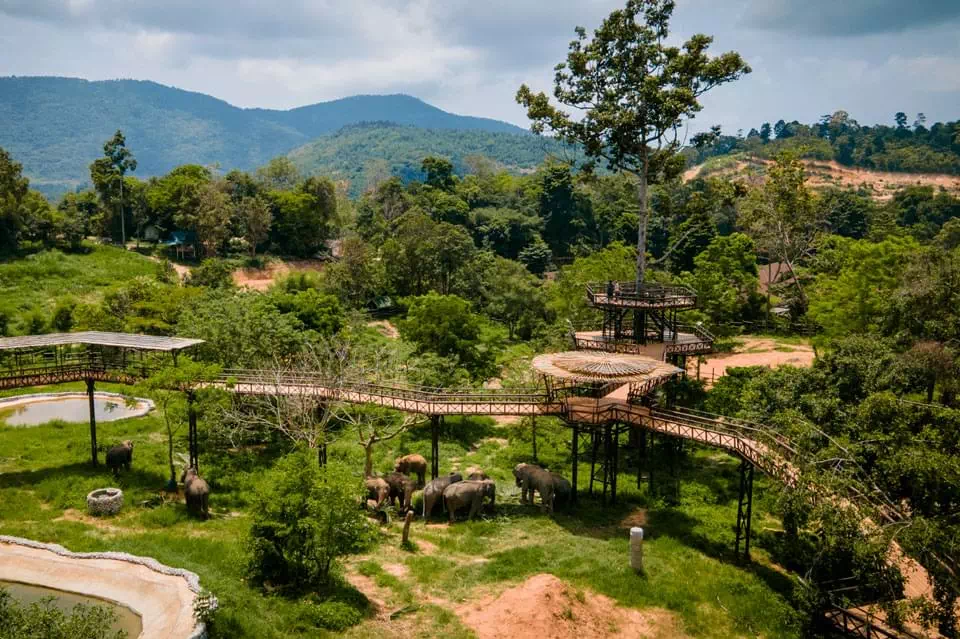
The park was founded in 2019 by Chokchai Ruengsri, whose family has worked with elephants for several generations. It was built on the idea that elephants deserve real freedom. Every elephant there was rescued from the logging industry or from tourist shows, where they spent years under stress and in confinement.
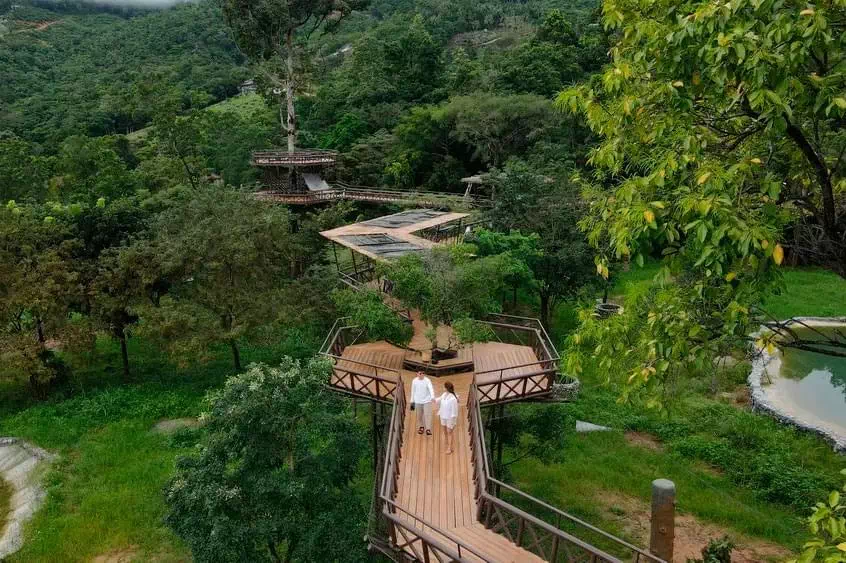
The design of the visit supports this. The centrepiece is a 400-metre floating Skywalk, the first of its kind on Koh Samui, which runs above the sanctuary. From there you watch the elephants roam, forage, interact with each other and splash in the pool, without walking into their space. It is a good way to see natural behaviour rather than a staged moment.
Visitors also prepare health balls of rice, herbs and spices that support the elephants' immune systems, and feed them by hand. After that, the guide brings the group down into the park, where guests can stroke the elephants and take photos beside them, with a team that knows every elephant by name managing the whole thing.
For the full step-by-step programme, including what is included, see the Samui Elephant Kingdom tour page, or read our earlier article on what actually happens during a visit.
It can be, when it is done on the elephants' terms and supervised by staff who know them. Feeding is the most natural way to interact with an elephant, because they spend most of their day eating anyway, and a visitor with food is welcome company.

I want to be honest here. Some people argue that the most ethical option is no contact at all, only observation from a distance. That is a fair position, and if it is yours, you will enjoy the Skywalk part of a visit most and can stay back during the hands-on part. A well-run sanctuary will never force contact on either the visitor or the elephant.
What crosses the line for me is contact that ignores the animal: crowds pushing in for selfies, people climbing on a lying elephant, or keepers pulling an elephant towards guests. Stroking an elephant that has come close by itself, with a keeper standing next to you, is a different thing.
Bathing with elephants is a separate debate. In some places it is gentle and fun for both sides, in others the elephants are made to stay in the water for one group after another. If a park you are considering offers it, ask how often it happens each day and whether the elephants can leave the water when they want.
Choose a place with no riding and no shows, follow the keepers, and let the elephants set the distance. Your behaviour on the day matters as much as the place you pick.
A few habits make a real difference:
Plan practical things as well. The Samui Elephant Kingdom visit takes about 4 hours, from ฿2890, with hotel pickup and drop-off, welcome tea and coffee, snacks and a buffet lunch included. Bring sunscreen, a hat, sunglasses, closed-toe shoes and insect repellent, because you will be outdoors in the jungle heat.
Go with the right expectations, too. Elephants are not on a schedule. Some days the herd comes straight to the walkway, other days a couple of them prefer the pool or the shade at the far end. That is not a bad visit, it is the proof that you are at the right kind of place.
The sanctuary suits travellers who want to see elephants up close without riding, and it is a good choice for families, couples and anyone who cares how the animals are treated.
If you are building a full week of plans, our list of the 10 best tours in Koh Samui puts the elephant visit next to the island's other favourite trips, and every tour is listed on the Go Samui Tours home page.
Yes. Samui Elephant Kingdom is an ethical sanctuary with no riding and no chains. Its elephants were rescued from logging and tourist shows and live freely on more than 4 hectares of jungle.
Some places may still offer it, but you should not ride an elephant anywhere on the island. Riding depends on harsh obedience training and puts strain on the elephant's back.
No. It is lighter than a seat, but it still needs the same training to make the elephant obey, and it still treats the animal as transport for a photo.
Check what happens, not what the sign says. Look for no riding, no shows, no chains, rescued elephants with known histories and elephants that move and behave freely. Guest photos often tell you more than official ones.
Shows with painting, football or tricks rely on training elephants to perform on command, often with pain or fear. An ethical sanctuary does not run shows of any kind.
Yes, when staff provide the food and supervise the feeding. At Samui Elephant Kingdom visitors prepare health balls of rice, herbs and spices and feed the elephants by hand.
All of them were rescued from the logging industry or from tourist shows. The guide can tell you more about individual elephants during the visit.
Hotel pickup, insurance and a licensed local operator. Ask us anything on WhatsApp before you book.
Updated 25 October 2026.