WhatsApp
+66-957-269-990
- info@gosamuitours.com


Everything you need for the first hour on Samui: what the open-air airport looks like, how to reach Chaweng, Lamai, Bophut or Maenam, where to get a SIM card and cash, and when flying via Surat Thani makes more sense.

The plane door opens, you walk down the steps onto the tarmac, and a small open-sided tram takes you to a terminal that looks more like a resort lobby than an airport. There are thatched roofs, palm trees and no glass walls between you and the warm air. Koh Samui airport is one of the nicest places to land in Thailand, and the first hour on the island is easy if you know what to expect.
I have met friends, family and guests at this airport more times than I can count. Here is what actually helps on arrival, and a few honest words about what it costs to fly in.
Koh Samui airport is a small, open-air airport with garden-style terminals, built in a tropical style rather than as a big concrete hall. It is compact, so you are usually out of the building and in a car soon after landing.
Arriving passengers often walk across the tarmac or take a little open bus to the terminal. Baggage claim is under a roof but open to the breeze, and the whole place feels relaxed. There is no long walk through endless corridors like in Bangkok.
Most flights come from Bangkok, with some regional routes from other Asian cities depending on the season. International arrivals have immigration at Samui, so if you fly in from abroad on a direct route, you get your stamp right here.
Inside the arrivals area you will find the basics: taxi and minivan counters, hotel representatives with name signs, a currency exchange, ATMs and phone shops selling SIM cards. Outside is the pickup area where hotel cars and transfer drivers wait.
The departure side is just as pleasant, with a small shopping street and cafes under the palms. If you leave Samui on the same airline, you might find the wait one of the calmest moments of your holiday.
The airport is in the northeast of Samui, between Bophut, Big Buddha and Choeng Mon, with Chaweng just to the south. Most popular beach areas are a short drive away, which is one of the big advantages of flying straight to the island.

Here is a rough guide to how the main areas compare. Times change a lot with traffic, especially in Chaweng in the evening, so treat these as relative, not exact.
| Area | Distance from the airport | What it is like | Good for |
|---|---|---|---|
| Big Buddha, Choeng Mon, Plai Laem | Very close | Quiet bays, resorts, temples | Couples, families, short transfers |
| Bophut and Fisherman's Village | Very close | Calm beach, restaurants, walking street | First-time visitors, couples |
| Chaweng | Close | The busiest beach, nightlife, shops | Groups of friends, people who like action |
| Maenam | A bit further west | Long quiet beach, local feel | Long stays, families, quiet holidays |
| Lamai | Further south | Lively but more relaxed than Chaweng | Mixed groups, mid-budget travellers |
| South and west coast | Furthest | Rural, sunsets, few tourists | Villas, people who rent a car |
Even the far side of the island is not a huge trip compared with big islands like Phuket. Still, after a long journey, a hotel close to the airport makes your arrival and departure days much easier, especially with children.
The easiest way is the official taxi or minivan counter in the arrivals hall, which sells rides at a fixed price to every part of the island. Agree on the price at the counter, and you will not need to negotiate with anyone outside.

There are several options, and which one is best depends on your group and your hotel:
One thing you will notice: Samui taxis rarely use the meter, even though many cars have one. Fixed prices are the norm here, and they are higher than in Bangkok. That is island reality, not a scam aimed at you personally.
For a family with luggage, I would not try to save money on the first ride. A taxi from the counter gets you to the pool fastest, and that matters more than the small difference compared with a shared van.
Each beach area has its own little quirks on arrival day. The main thing to know is that Chaweng traffic, not distance, decides how long your ride takes.

Chaweng is close to the airport, but the beach road is narrow and busy, especially in the late afternoon and evening. If your hotel is on the beach side, the car may have to drop you on a side lane and walk your bags in. Ask your hotel in advance how cars reach the entrance.
Chaweng also has the most shops, ATMs and phone stores, so if you missed something at the airport, you can fix it within minutes of checking in.
Lamai is south of Chaweng, and the road between them climbs over a hill with sea views. It is a longer ride than to Chaweng, but still easy. Lamai is a good choice if you want a lively beach with less noise, and it is close to the famous Hin Ta and Hin Yai rocks.
Bophut is the closest beach area to the airport, and arrival here is usually painless. Some hotels in Fisherman's Village are on a narrow walking street, and on Friday evenings the walking street market can make car access difficult. If you land on a Friday afternoon, mention it to your driver.
Maenam is further west along the north coast. It is quieter, more local, and the ride is a little longer but on a simpler road. Many long-stay visitors choose Maenam because it is calm and closer to the piers for Koh Phangan and Koh Tao.
Maenam also has fewer late-night shops than Chaweng, so if you land in the evening, buy water and snacks at a convenience store near the airport or ask the driver to stop at one on the way. Drivers are used to this request and it only takes a few minutes.

You can buy a Thai tourist SIM card and withdraw cash right in the arrivals area. Bring your passport to the phone counter, because a tourist SIM must be registered with it.
The big Thai mobile networks have counters in the airport, and they sell tourist packages with data for a set number of days. Staff will usually install and test the card for you. If your phone supports eSIM, you can also buy one online before you fly and switch it on when you land.
ATMs at the airport work with most international cards. Thai ATMs charge a fixed fee per withdrawal for foreign cards, so it makes sense to take out a reasonable amount at once rather than many small sums.
The currency exchange at the airport is convenient, but the rates are rarely the best on the island. Change only what you need for the first day or two, then use exchange booths in Chaweng, Lamai or Bophut, which usually offer better rates.
Cards are accepted in most hotels, bigger restaurants and shops, but cash is still king for street food, small cafes, markets and taxis. Keep some small notes for tips and snacks.
Often yes. Flights to Samui are usually more expensive than flights to Surat Thani on the mainland, but the cheaper route costs you several hours of bus and ferry travel each way.
Samui airport has a limited number of airlines and slots, and that keeps prices higher. Surat Thani is served by low-cost airlines, and from there you take a bus to the pier and a ferry across to Samui. Combined tickets are sold at the airport in Surat Thani.
Here is how I see the trade-off. If you are a backpacker or have a flexible schedule, Surat Thani can save real money and the ferry ride is pleasant on a calm day. If you travel with children, a lot of luggage or only a week on the island, the direct flight gives you back most of a day of holiday.
There are a few things to weigh honestly:
A middle path some travellers like: fly into Samui to save the arrival day, and leave via the ferry and Surat Thani at the end of the trip, when you are rested and less fussed about a long day. It splits the cost and keeps the first day of the holiday free.
The full comparison of flights, ferries and buses deserves its own article. For the season question, the month by month weather guide for Koh Samui will tell you when the sea crossing is usually calm.
Keep the first day simple: beach, food and sleep. Most popular tours pick you up early in the morning, so book them for day two or three, not for the day you arrive.

The good news is that almost every activity on Samui includes hotel pickup and drop-off, so once you have arrived you will not need to sort out transport again. You can see all of them on gosamuitours.com, with prices and pickup times by area.
The three activities guests book most are the jet ski safari to Pig Island, the Hawk Adventure zipline and the jungle ATV or buggy safari. The jet ski suits couples who want speed and islands, the zipline suits anyone who wants a short adrenaline hit in the jungle, and the ATV suits people who like mud, views and waterfalls.
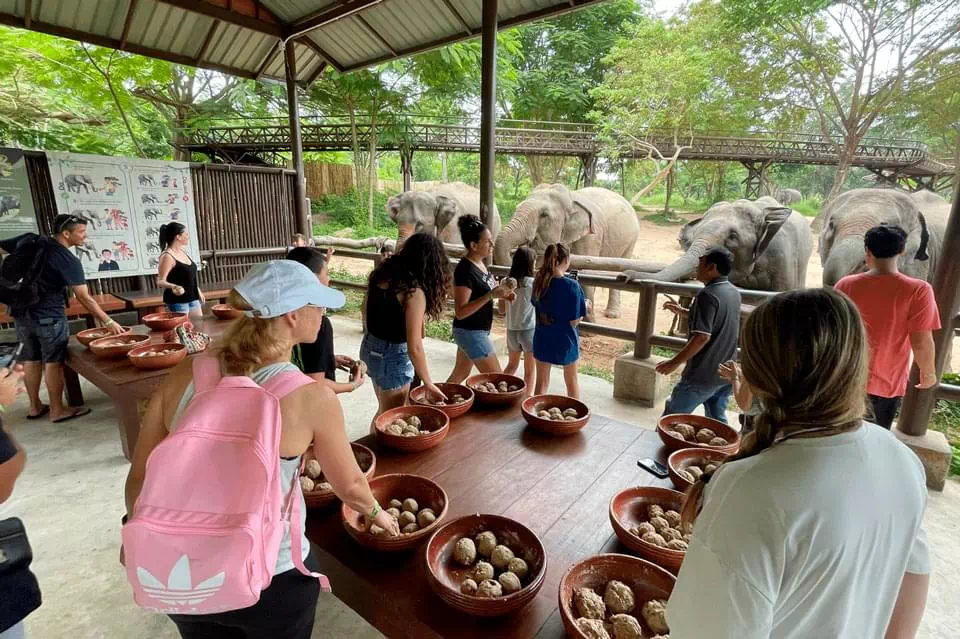
If you are not sure which to pick, read this comparison of jet ski, zipline and ATV on Koh Samui. For a calmer half day, especially with kids, the Samui Elephant Kingdom sanctuary visit is an easy first outing: no riding, no chains, just feeding and watching the elephants, from ฿2890.
A little preparation makes the first hour on Samui as relaxed as the airport itself.
Do that, and your Samui holiday starts the moment you step out of the plane into the warm air, not after an hour of confusion at the exit.
The airport serves scheduled flights and is not a round-the-clock hub. Flights usually land and depart from early morning until the evening. Check your airline's timetable, and if you land late, arrange your transfer in advance.
Most flights are from Bangkok, operated mainly by the airline that owns the airport, with some services by partner and regional airlines. Routes from other Asian cities change by season. Check current schedules when you plan your trip.
Grab works on Samui, but airport pickups can be limited and cars are not always available. Many travellers find the official taxi counter faster. Use Grab as a backup rather than your only plan.
It helps to have some. Taxis, street food and small shops usually prefer cash, while hotels and bigger restaurants accept cards. There are ATMs in the arrivals area, so you can withdraw on landing.
Because the airport is small and close to most beaches, you do not need to leave hours early. Allow extra time for Chaweng traffic in the evening and for check-in rules of your airline. Your hotel reception will tell you the usual timing from your area.
Yes, but not by plane. You need a taxi to one of the piers on Samui and then a ferry or speedboat. Ferries do not run late, so if you land in the evening, it may be easier to spend one night on Samui first.
There is no public bus route of the kind you find at big city airports. Shared minivans are the budget option, and some hotels run their own shuttles. Local songthaews (shared pickup trucks) run along the ring road but do not normally serve the airport.
Hotel pickup, insurance and a licensed local operator. Ask us anything on WhatsApp before you book.
Updated 12 November 2026.