WhatsApp
+66-957-269-990
- info@gosamuitours.com


A practical guide to the garden a farmer built in the hills of Koh Samui: who he was, what you will see, how bad the road really is, and the easiest way to get up there.
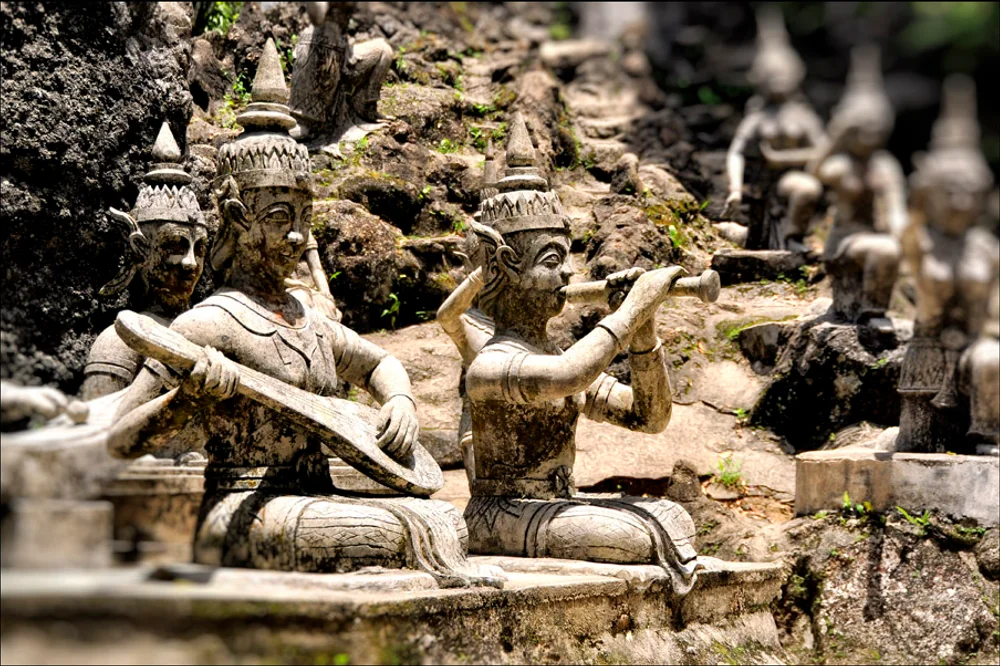
The concrete road tilts so sharply above the last orchards that the scooter ahead of you slows, wobbles, and its passenger climbs off to walk. A little later the engine noise is gone and you are standing in cool shade, looking at a stone band that has been playing silently in the jungle for decades. That is the Secret Buddha Garden, and the road is part of the story.
I send friends up here more often than to many of the famous stops on Koh Samui, but I also tell them plainly how to get there. This guide covers the farmer, the statues, the road and the choice between going alone and going with a tour.
It is a small sculpture garden high in the hills in the middle of the island, built by one man on his own family land. You will also see it signposted or described as the Magic Garden, and sometimes as Tarnim. All of these names point to the same place.
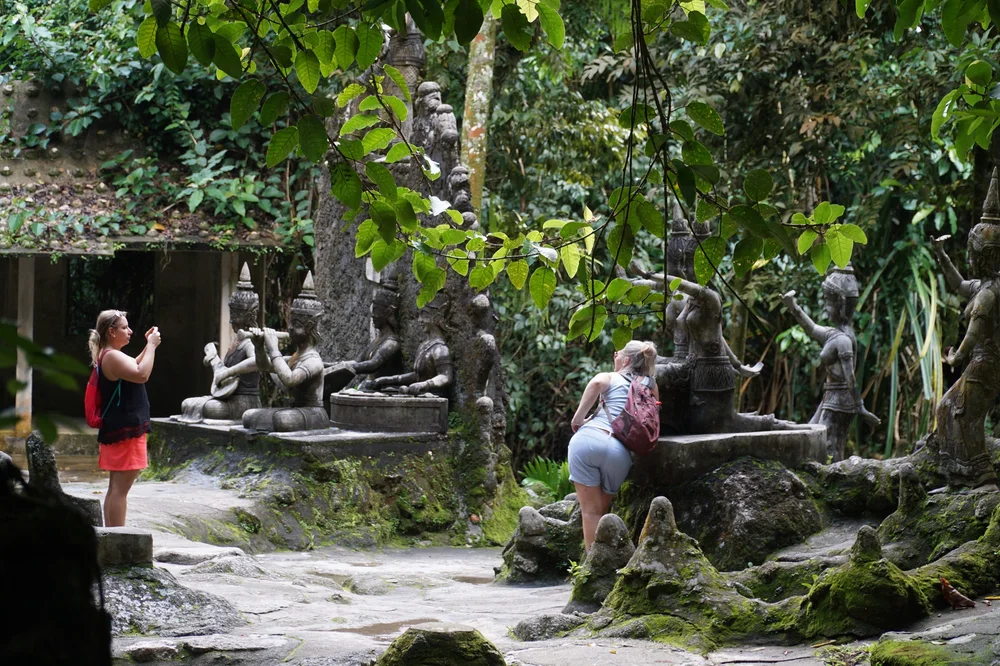
Do not expect a temple. Despite the name, this is a personal, slightly eccentric garden rather than a working religious site, with no monks, no ceremonies and no big halls. Deities, musicians, dancers, animals and ordinary people stand together among the trees, and it is up to you to make sense of them.
It is also not large. Most people walk it slowly, take their photos and sit by the water for a while, then feel ready to move on. That is why it works better as one stop in a day in the hills than as a long trip of its own.
The appeal is the setting as much as the art. The air is noticeably cooler than down on the coast, moss has crept over almost everything, and water runs through the middle of the garden. After a few days of hot beaches, this feels like a different island.
The garden was the life work of Nim Thongsuk, a local farmer who grew fruit on this land. He began placing statues among his trees late in life, and the usual telling is that he started in the 1970s, already well into old age.
He had no reason to do it beyond wanting to. By the common account he hauled materials up the hill himself, long before the road was anything like it is today, and shaped the figures one at a time. He kept working on the garden until the last day of his life and died at the age of 91.
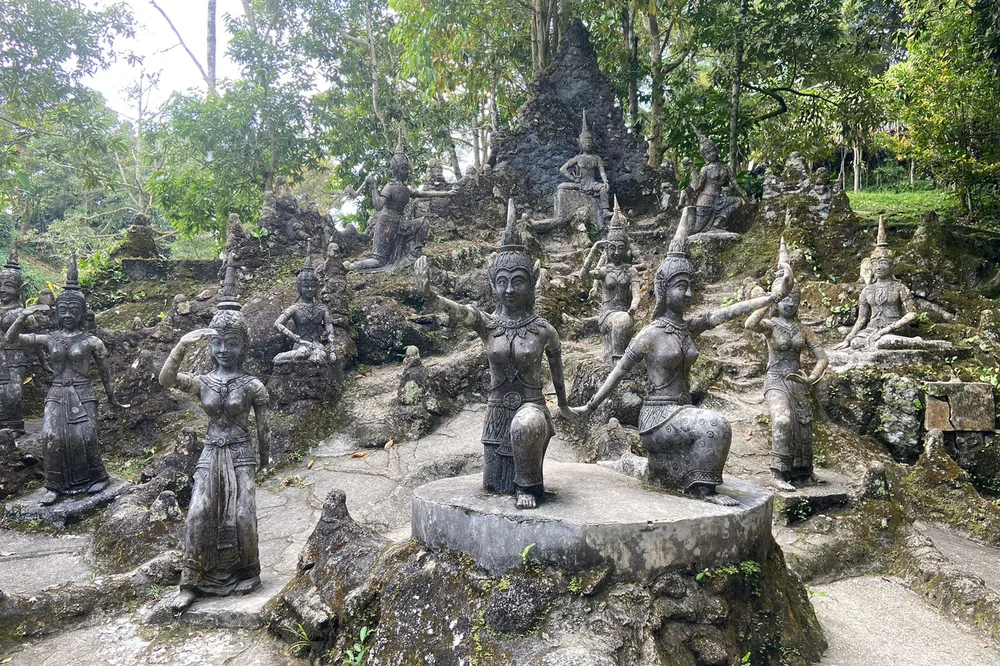
Knowing this changes how you look at the place. The figures are not polished, and some are frankly odd, with expressions you would not find in a temple workshop. They look like what they are: the work of a determined farmer teaching himself as he went along.
Most descriptions call them stone statues, and with the moss on them that is how they read. Look closely, though, and many appear to be cast and hand-finished from a cement mix, which would make sense for one old man working alone on a steep hill. If you want the full story of a particular figure, ask the guide on your tour, because there are few signs on site and the stories told vary.
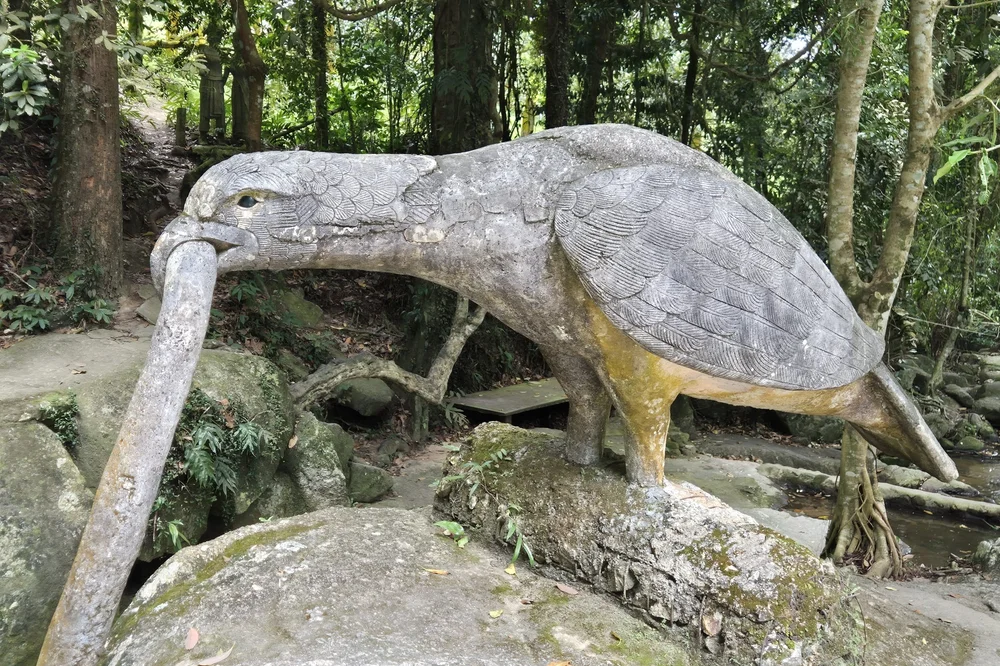
Expect dozens of figures spread across the slope: the military jeep safari page counts over 100. They are scattered rather than arranged in rows, so you keep finding new ones behind a tree or on a rock above the path.
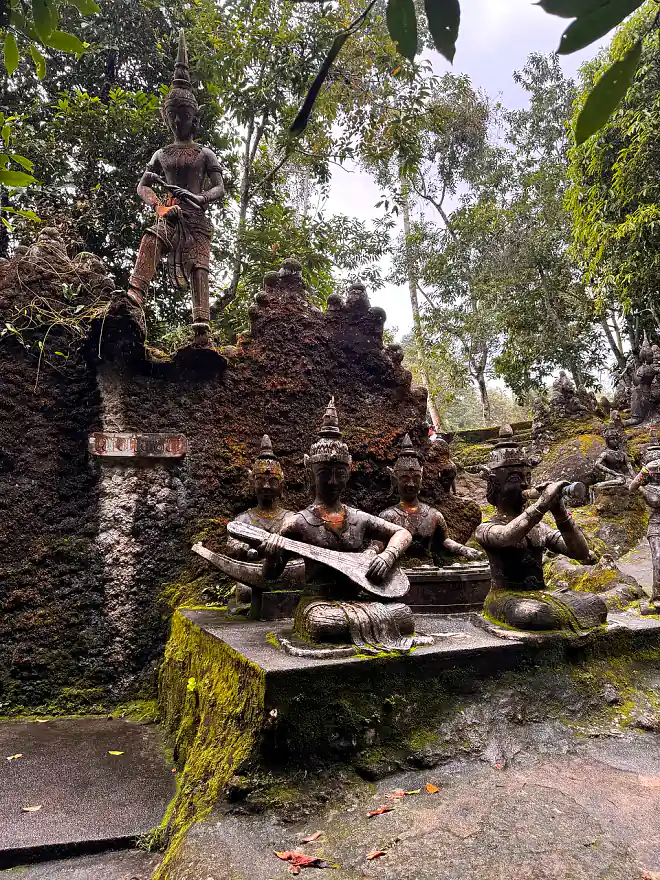
These are the ones I always point out to first-time visitors:
Be respectful, even though it does not feel like a temple. Some figures are religious, and climbing on them for a photo is bad manners anywhere in Thailand. Rocks and steps are often slippery with moss, so go slowly, particularly with kids or if you have just come off a sweaty ride.
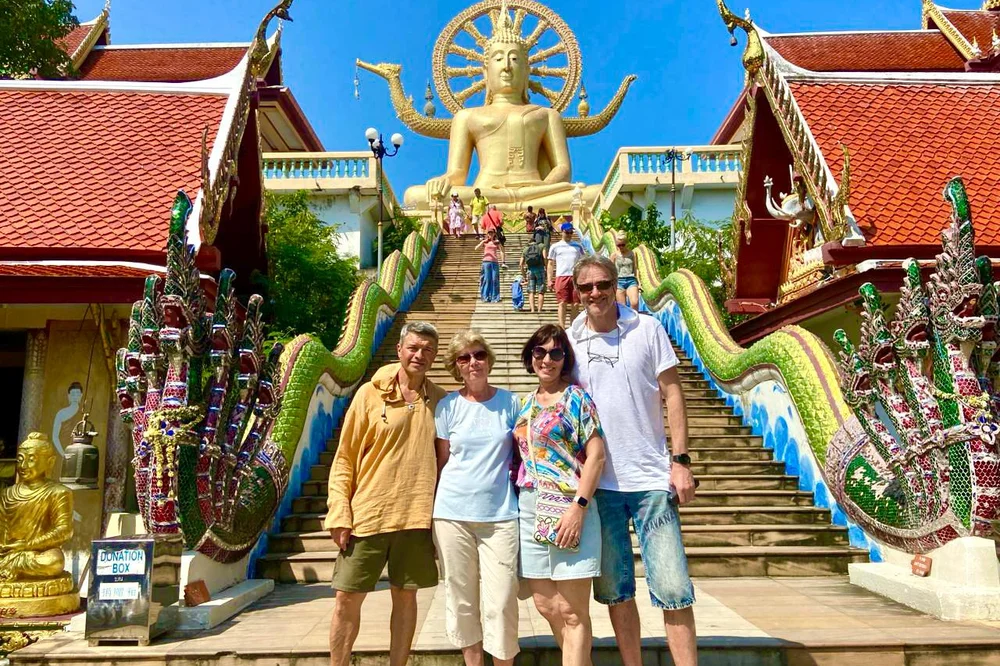
My honest opinion: if you love tidy, grand attractions, this may underwhelm you. Go to the Big Buddha temple for gold and scale. Come here for atmosphere, strange little details and the feeling that somebody cared about this hill for a very long time.
Very steep. Parts of it are among the hardest public climbs most visitors will meet on Samui, with sharp bends, patched concrete and stretches of loose grit. It is not a road for inexperienced scooter riders, and I would not call it a place to learn.
The problem is not only skill. A small automatic scooter with two people on it can run out of power on the worst sections, which is exactly how the passenger ends up walking in the midday heat. Stopping and restarting on a steep slope is where riders drop their bikes.
Coming back is the real test. You spend a long time on the brakes, and rental scooter brakes are not always in great shape. Many of the scooter injuries on Samui have nothing to do with speed: they come from someone who was fine on flat roads meeting a hill they were not ready for.
Rain makes all of this worse. After a downpour the road can stay slick for hours, runoff carries gravel across the bends, and the climb becomes a bad idea even for decent riders. Skip it entirely in the wet stretch of the year unless you are on a tour with the right vehicle.
An ordinary small rental car is not a great answer either, as it can struggle on the steepest parts and leaves you little room to pass. If you are a confident rider with a proper licence and a stronger bike, on a dry day, it is doable. Check that your licence and travel insurance really cover you first, because many policies do not cover riding without the right licence.
For most people the answer is a jeep tour. Someone else drives the hard part, and the garden comes with several other stops on the same day. You lose some freedom, since a tour keeps moving and you do not choose your hour there, but you also lose all of the risk above.
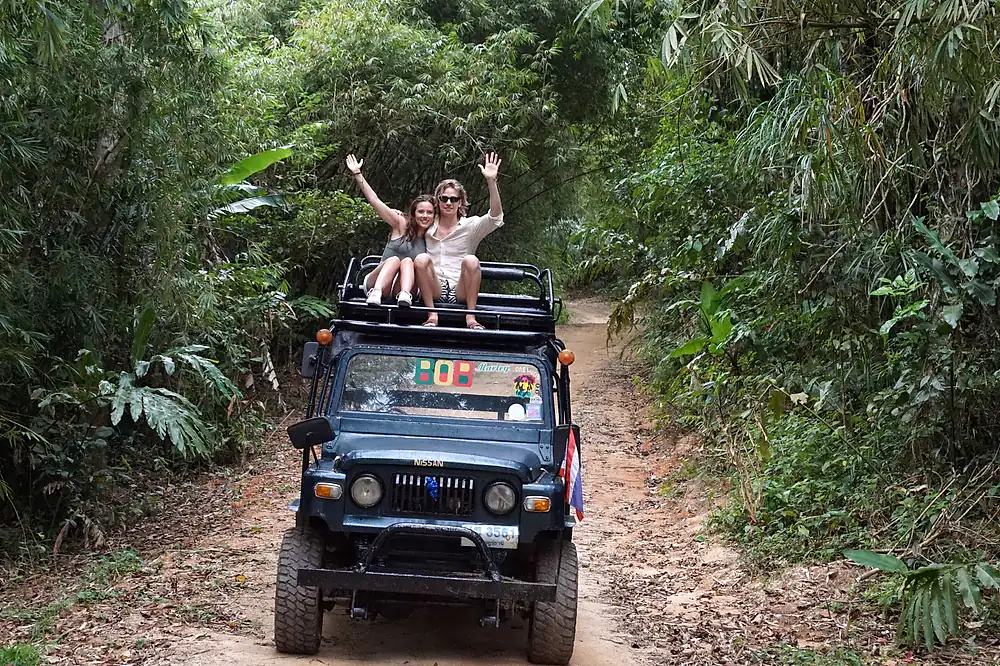
Here is how the three tours and the do-it-yourself option compare. All three tours include a hotel transfer and a guide.
| Option | Who drives | Length | From | Best for |
|---|---|---|---|---|
| Jeep safari | The tour driver | 8 hours | ฿1490 | First-timers who want the island highlights in one day |
| Military jeep safari | The tour driver | Full day | ฿1490 | Groups who like old 4x4s, mud and a bit more jungle |
| ATV, 4-hour route | You, after training | 4 hours | See tour page | Active people who want to do the driving themselves |
| Own scooter | You | Your choice | Rental only | Experienced riders on a dry day only |
The classic jeep safari is the sensible all-rounder. The powerful 4WD jeeps take you around Big Buddha, Wat Plai Laem, Namuang Waterfall and the Grandfather and Grandmother Rocks as well as the garden, and lunch is at a panoramic restaurant with Thai food, fruit and drinks.
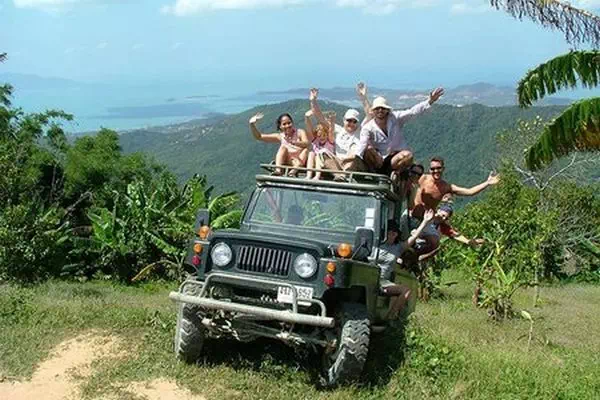
The military jeep safari uses vintage 4x4 army vehicles and has a rougher, funnier feel. Its route takes in Wat Khunaram with its mummified monk, a swim at Namuang, off-road mountain tracks, then the garden after lunch. It is my pick for a group of friends. Neither jeep is air-conditioned comfort, so expect dust, sun and bumps.
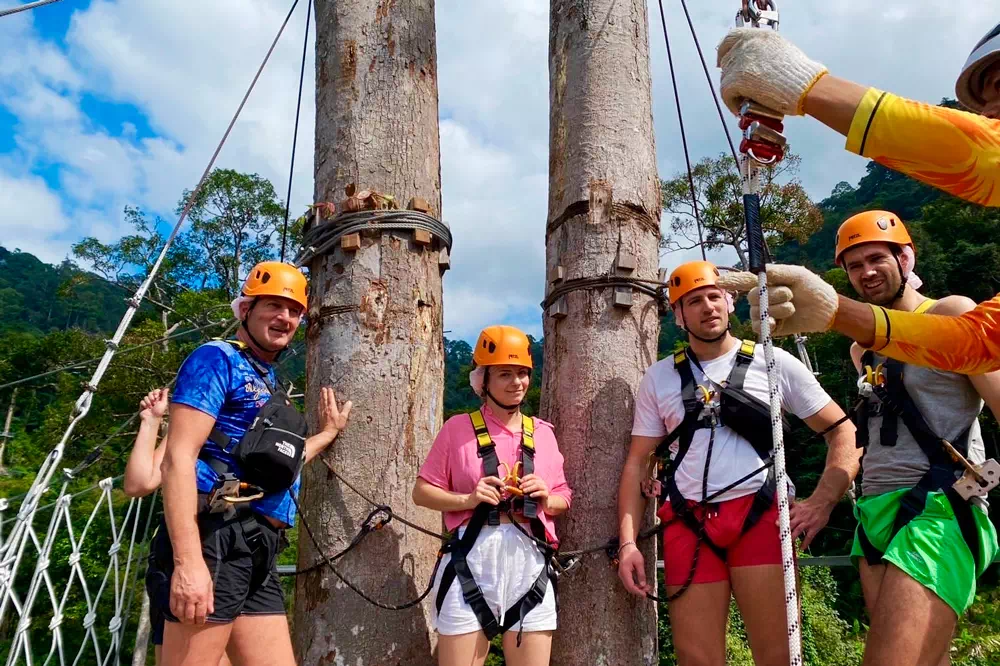
The ATV choice needs care. The quad and buggy page has several programmes, and only the 4-hour route lists the Magic Garden, together with Teepangkorn temple, viewpoints and a waterfall in season. The 2-hour route from ฿2190 and the 3-hour route from ฿3290 go to a viewpoint, a secret waterfall and, on the longer one, a temple, but not to this garden. Read the route line before booking, and see the honest ATV guide if you have never ridden one.
Choose the classic jeep for a first look at the island, the military jeep for a more rugged day with friends, and the 4-hour ATV route if driving is the whole point for you.
Yes, and you should, because the hills are the reason to come. The garden sits in the same high interior as most of the island's best lookouts, so one climb can cover several of them.
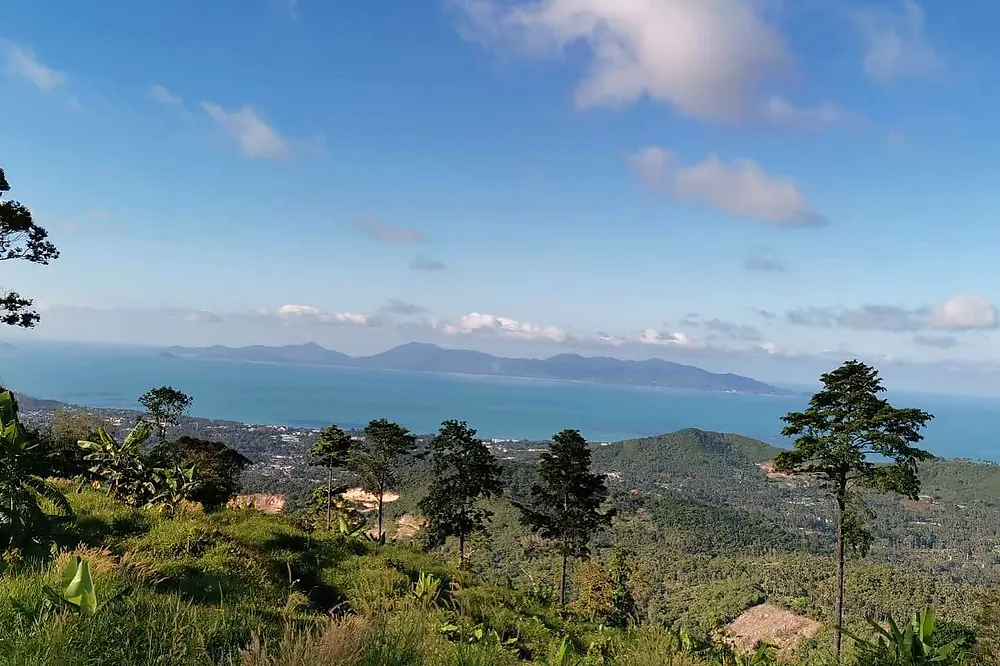
The jeep safari ends with its big finale: an off-road climb to Pra Buddha Teepangkorn temple at 605 metres above sea level, the highest point on the classic route and the best view of the day. The garden and that summit together make the case for this tour over any beach-side sightseeing.
The military jeep route stops at elevated viewpoints over the southern coast before the garden, then finishes at a mountaintop Big Buddha temple with a 360-degree panorama. On the 4-hour ATV route you get the garden, Teepangkorn and viewpoints in one ride, which is a lot of hill for a short day.
Going on your own? Keep it simple and plan one hill area for the day rather than trying to link every lookout. These back roads look short on a map, they take far longer than you think, and the small cafes up here have hours that change with the season, so check on the day.
There is a cost to all this: time. A full-day safari packs in a lot, and you will not linger at every stop. If you know you want an hour of sitting quietly with the statues, a tour is not your format, and a confident driver in a suitable vehicle is the better plan.
Go in the morning or later in the afternoon if you are travelling on your own, and choose a dry day. Tours run on their own timing, so you simply get the hour you get. Dry weather matters far more than the time of day, for the road and for the slippery steps alike. The month-by-month weather guide helps with planning, and the wet weeks usually come late in the year.
There is an entrance fee at the gate for independent visitors. It is not high by island standards, but it can change, so check on the day. If you are on a tour, ask when you book whether it is included in your programme.
A short packing list that will save you some trouble:
Dress modestly enough to feel comfortable around religious figures, particularly if the same day includes real temples, where shoulders and knees should be covered. A light scarf or sarong in your bag solves this for any stop.
To book, send the request on the tour page or message us on WhatsApp with your hotel and date, and mention that the garden is the stop you care about most. That one line helps us point you to the right route, and it stops you from booking a programme that never goes near the place.
Yes. The names Secret Buddha Garden, Magic Garden and Tarnim all refer to the same hillside garden on Koh Samui. Tour pages and road signs may use any of them, so do not worry if a route says Magic Garden.
Only if you are an experienced rider, the road is dry and your licence and insurance cover you. The climb is very steep and the descent is harder on brakes and nerves. Beginners should take a jeep or ATV tour instead.
Some drivers will go and some will refuse, because the top section is hard on ordinary vehicles. Ask before you leave and agree on waiting time and the fare up front. A tour in a 4x4 removes that uncertainty.
Most visitors feel they have seen it after a slow walk and some photos, then sit by the stream for a while. It is a small place, which is why it suits a day with other stops. Photographers may want longer, and that is easier if you come independently.
Generally yes, and kids often enjoy hunting for the animal statues. The steps can be slippery, so hold small hands on the wet sections. On the ATV tours, children from 12 can drive a quad themselves subject to ability, and a quad also takes an adult with a child.
It is a private garden rather than a working temple, so there is no strict rule that I know of. Still, some of the figures are religious, so behave respectfully and do not climb on them. If your day also includes temples, bring something to cover shoulders and knees.
No. On the programmes sold on gosamuitours.com, only the 4-hour route lists the Magic Garden. The 2-hour and 3-hour routes have different stops, so check the route line on the tour page before you book.
Hotel pickup, insurance and a licensed local operator. Ask us anything on WhatsApp before you book.
Updated 27 November 2026.